Labels

Showing posts with label Evaluation. Show all posts

Monday, 14 March 2011

Question 7- Looking back at your preliminary task (the continuity editing task), what do you feel you have learnt in the progression from it to full product?

Looking back at the preliminary task and what we have achieved now, I can say that I have learn t a lot of things such as new skills and learning how to use more programmes. In our preliminary task we were required to produce a scene where a person opens a door and exchanges some sort of dialogue between them. This would show our skills in editing as this was the main reason for this task, as when filming our real sequence we needed good editing techniques in order for it to flow well and therefore to be a successful thriller opening sequence.  As this was one of the first tasks we were given we didn’t know much about the camera shots. We knew the basic, extreme close up and close up. We included other shots like , shot reverse shot and 180-degree angle as this was one of the main aspects of the task. we also focused on match on action, as we needed the continuity to work well. Also in order to give our shots some meaning or power we needed to consider low/high angle camera shots. As we didn’t know much information about these types of shots and why they are used we did some research. This helped us as we then knew how to do the perfect shot for our opening sequence. The preliminary exercise taught me that to make a film successful, the shots have to flow well and the continuity should be perfect.

Not only have i learn't the shot types but i have learn't how to use more programmes. The main programme we used for editing was Final Cut Express. I have developed the skills rapidly as the editing in the final sequence was very good. Also the titles in the preliminary task where done on a programme called after affects. As this was new to us, we didn’t know how to use it and therefore just produced basic titles. However know we used different skills as we wanted our titles to fit into the actual image shown on screen.
For this task, we did not carry out vast amounts of research, except the types of camera shots we were going to film. We did this by drawing a detailed storyboard which consisted of what shots we were going to do and where. This was a good task for us as this helped us later on when creating our actual film opening. Also in our thriller opening we researched more in depth of how we were going to produce it and what our narrative was going to be about.

For out final product we had to produce a thriller opening sequence from a sub-genre from your choice. We had to do more in depth research into the narrative expectations as if this was good then our film would be. We used many films from inspiration but our main one was seven. As we wanted to base our movie on a psychological thriller this was the perfect film. We also planned out our shots in more depth as this was essential. 


Here the same type of shot is being used. You can see that it is a very low angle shot which indicates high status of the character. You can see that the shot in the preliminary task isn’t very good as to much is being revealed and therefore it doesn’t show our main focus. This is more of a long shot. This reveals the location of the character which is something we didn’t want. However in the shot we done for our opening sequence it shows more focus on one thing which makes the shot more powerful. Also rather it being a long shot we decided to go for a close up, this would also help the viewer focus on the image more. 


When the actor comes from the door the camera is placed at a high angle. This doesn’t work well within the scene as again, too much is being revealed. However the high angle shot we used in our final sequence is close and therefore gives the high authority towards the actor. Also the subsequent shot was a low angle that gradually moved up, becoming a high angle. This was good as it alerts the viewer. Now i think the best shot would be a low angle close up as then you can’t see the outskirts allowing the reader to closely focus on what is happening. 


In the shot from the preliminary task you can see this is again, a high angle shot of a person trying to open the door. As our main task was to show a person walking through a door, I can now see we have used the wrong shot selection as this should have been a close-up of  the hand. this would allow the shot after (of the guy walking threw the door) to be more successful in term of continuity. The shot from our new opening sequence is a low angle close-up. This was a good shot as it fitted in well with the next shot. However the continuity was poor for the preliminary task as then we couldn’t edit the next shot well with the one shown. 


In our preliminary task we used a close-up straight after Omar entered the door. This wasn’t the right shot to use as then the continuity didn’t flow. However in our final thriller opening we used a close-up but also positioned the camera in a certain way to capture exactly what was going on. Also we thought about the next shot and how the camera will change from its low angle positioned. This allowed the continuity for the two shots to be smooth. If I redid the last shot in the preliminary exercise it would have done a medium shot at a side angle, as then the continuity would flow.

Overall, I feel that our thriller film opening was quite successful as we meet the requirements of a thriller opening sequence. One of the most successful things about our sequence was our lighting. the effects we created on lighting using after affects was good and allowed our whole sequence to look scary.


Question 6- What have your learnt about technologies from the process of constructing this product?


Sunday, 13 March 2011

question 5- How did you attract/address your audience?


This is a video we made in order to get feedback after users watched our opening sequence. We thought, by making a video we would get a better analysis on our opening sequence. We were also able to “wire frame” the footage enabling us to fit it in what was being said.

We choose to select people that reflected our target audience, which was 15+. This allowed us to gain feedback from a range of users from different ethnicities. As we didn’t make a film poster to promote our film, we could send out film to TV companies so they can review our sequence on their show. This will allow viewers to watch our opening for free and give us feedback.
  
You can see that from the feedback given from the first male was very good. He said that our sequence was scary, which was exactly what we wanted it to be. This was because of our character being “unknown”. This idea was based on our results from our questionnaire. Also as we wanted the thriller opening to build anxiety and tension, we thought we could do this by the making the lighting much darker. This was, again successful in the outcome we wanted it to have as from our feedback given in the video the male said it added this affects.  This was said by all 4 interviewees that we interviewed making our sequence exactly what we wanted it to be, in terms of how it made the audience feel. Furthermore the second female said that the close up used added to the tension. This was a good relief as this was the main idea (using close-ups to attract the viewer).

Thursday, 10 March 2011

Question 3- What kind of media institution might distribute your media product and why?


This is a video we produced with our commentary of the distribution. 

Tuesday, 8 March 2011

In what ways does your media product use, develop or challenge forms and conventions of real media products?


The title of the film- the fourth frame of the 9 frame storyboard shows the title of the opening sequence, “psycho”. This is placed on a red misty backdrop which creates tension. One of the main reasons of using the colour red is that we thought it would create suspense and tension as it wasn’t just an ordinary red, it had a smoke affect to it. This made the title stand out more and gave it a sense of authority. This was one of our features relating to a thriller convention as to ensure your film is a thriller you have to ensure that you have something that creates an upbeat atmosphere. Furthermore, we used capital letters for the title. By doing this, it makes the title stand out while the audience are viewing. Not only did the background have the smoky affect, but the title did to. This was to build more fear for the audience and to make sure the title was eye-catching. The sense of red helps the sequence to seem the crime/psychological thriller we wanted it to be. It also gives a hint of the narrative.

Setting/location-Part of our opening sequence was filmed in the d.t room as the tables where very rough and messy. This was the ideal location as this would build tension and suspense. We needed a table that had some sort of writing and was very old as this would create the mood of the sequence. As we had tools lined up it gave a deeper sense of anxiety as everything was old and worn out. As we tried to build tension we wanted a room that was full white, with nothing in it giving a sense of isolation and mystery. But we couldn’t find this. Instead we came up with another idea. Filming in the d.t room meant there were all sorts of machinery around. This would immediately create tension as the machines where big and it related to our narrative. The audience may assume something disturbing or scary may occur as a result of the machinery e.g. a belt sander. Furthermore the first bit of our sequence was filmed in the hall way. As we had various plans of how our title should fit in with our sequence we decided to film where there was carpet and stairs. Also the lighting and atmosphere in this location was very good as the colours where very dull and blunt, which fitted with our sequence successfully.

Camerawork and editing- The sixth, seventh and ninth frame in the storyboard shows some of the different types of shots used within the opening sequence. One main convention of a thriller is to have different types of shots so the viewer is always alert and interested in the film. Rather than just doing medium and extreme close-ups we used a long shot and high/low angle shots. These shots emphasise the main actor’s authority and gives the sequence a meaning. Also as we had all these range of shots, the continuity was hard to do. However, using our skills learnt on Final Cut Xpress we done this successfully. When played, the sequence flowed well. All our shots where mainly focused on what the actor was doing, there wasn’t any type of dialogue in the sequence as we wanted the actor to be the main centre of attention. Using different shots allows the viewer to closely focus on what is actually going on.

Lighting- The third frame in our storyboard resembles the type of lighting used. We used dark lighting to highlight the tension built from the shot and the subsequent shots after. This helped us as it gave a sense that our sequence was scary and therefore meeting the requirements of a thriller. We varied the lighting from the beginning as then it showed how the story progressed onwards.

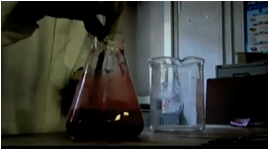
Genre- The ninth frame gives a impression of what the intended genre is for this thriller. You can see a guy is doing un-normal things as he has all sorts of cutlery/sharp objects out. He is mixing, testing, and examining things. This gives a scene of a crime/psychological thriller as the actor is seen as a mysterious guy who doesn’t want his identity to be revealed. This immediately builds tension. The audience are then interested as they might be thinking why is the guy doing all these unordinary things, is he planning something?. By this it makes the audience more interested in the film. The film “seven” reflects this as when i viewed it, questions started creeping into my mind. Also the audio helps to identify the genre of the filming as normally in comedy, adventurous films the music is normally clam, quite and slow pace. However in our opening sequence the audio is fast, loud which varies in tempo creating a tense atmosphere, which reflects our genre.

Special effects- The eighth frame shows the use of special effects that we done. As we filmed out footage during the day, we couldn’t get the dark lighting as we expected. Using After Effects we changed the lighting of all our footage making it more darker. This helped us as we wanted the audience to feel tension and anxiety when watching our opening sequence. Also, as we wanted some of our titles to actually be a part of our footage we had to use a programme called After Effects. As you can see in the first frame in our storyboard the title that is written on the door moves, as the door moves. This was so we had something interesting with our titles making our sequence look more professional.

Costume and props- frame five and four demonstrates what costume we used. To ensure that our character looked mysterious and scary, we used a plain white lab coat. This worked well as he was handling things like chemicals and knifes. This made out opening sequence look more realistic and professional. Also to go into more detail, rather than the person doing everything with bare hands, we used latex gloves as in a surgery or an operating theater gloves are used. This set the mood to the sequence as again, it looked professional.

Story and how the opening sets it up
- Right from the start of our sequence we wanted to build tension and suspense. This would give the viewer an insight of what type of genre the opening sequence will be. Also so the viewer doesn’t get bored we used a range of shots from high to low angles. This built great authority to the character. As we really wanted to hit the crime/psychological thriller we needed to come with an idea to do so. The basic outline of what is happening in the opening sequence is that a mysterious person is going through all sorts of phases to plan and kill someone. We showed this by him pouring things into the beaker and doing weird things with tools. This set the scene. Furthermore we never revealed the main characters face. From out questionnaire results we found that this was the main feature that our target audience wanted. This would build further tension. Also it makes the audience think and believe the unexpected.

Thursday, 3 March 2011

9 Frame Storyboard